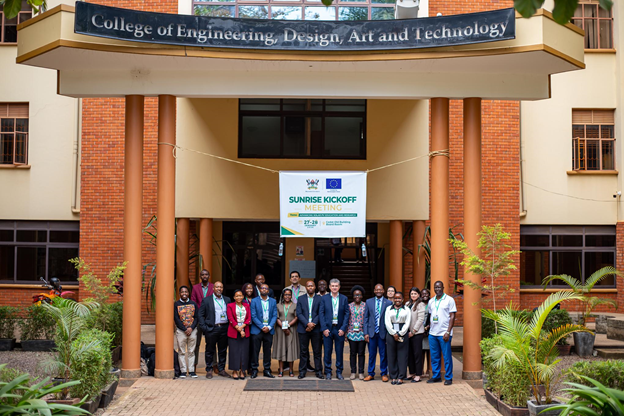
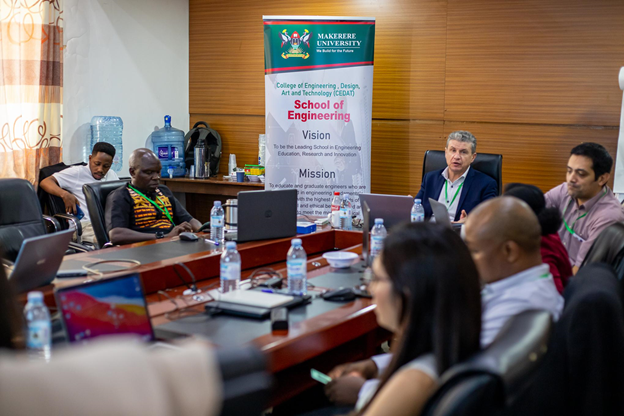
From January 27th to 28th, 2026, the Makerere University School of Engineering, under the College of Engineering, Design, Art and Technology (CEDAT), hosted a landmark workshop to launch the SUNRISE project. This initiative brought together a diverse team of engineering academicians from various universities across East Africa and Europe. Coordinated by Dr. Francis Mujjuni of the Makerere School of Engineering, the kickoff event marks the official beginning of a collaborative effort to transform renewable energy education in the region.
The Sustainable Universities for Renewable Innovation in Solar Energy (SUNRISE) project is a 36-month initiative funded by the European Union. It was born out of discussions in January 2025 between Dr. Mujjuni and European partners who identified the opportunity to form a strategic consortium. The primary mission of SUNRISE is to strengthen the capacity of Higher Education Institutions (HEIs) in Kenya, Tanzania, and Uganda, specifically focusing on advancing solar photovoltaic (PV) education and research to meet modern energy demands.
To bridge the existing gap between academic training and labour market requirements, the project will modernize six existing curricula. This transformation includes the introduction of twelve specialized micro-courses designed to equip students with essential digital, green, and entrepreneurial skills. Furthermore, the initiative will establish six SUNRISE Innovation Labs for practical research and implement “Train-the-Trainer” workshops and EU study visits to enhance faculty expertise. These efforts are complemented by the development of policy influence tools to foster stronger connections between academia and regional policymakers.
The project’s strength lies in its robust partnership, involving ten prestigious universities from Africa and Europe. Participating institutions include Makerere University, Kyambogo University, Strathmore University, and the University of Nairobi. The consortium also features The Nelson Mandela African Institute of Science and Technology, The University of Dar es Salaam, The University of Patras, The University of West Attica, Thomas More University of Applied Sciences, and ReadLab Brussels. During the kickoff, representatives from these institutions convened in person to align on work plans, timelines, and the project’s ultimate goals to ensure a successful outcome.

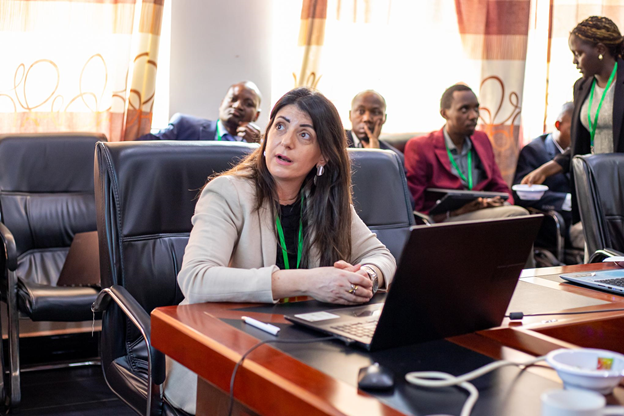
A critical component of the workshop was a session with Ms. Anna Hakami, a Project Adviser at the European Education and Culture Executive Agency (EACEA). She provided the partners with a comprehensive overview of the essential terms and conditions of the agreement with the European Union. This interaction allowed partners to seek clarity on specific deliverables and compliance requirements, ensuring that all regional and international stakeholders are aligned as they move forward with planned study visits and technical milestones.
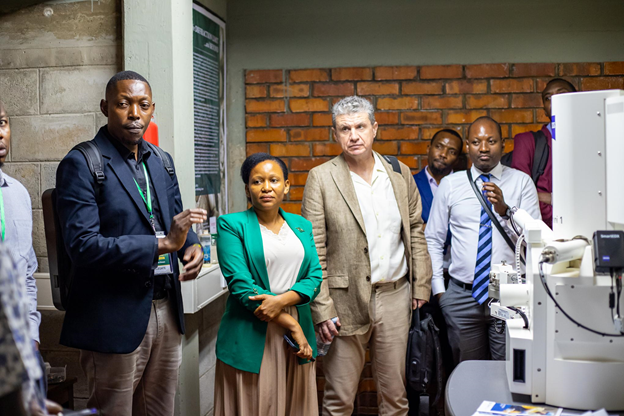
The workshop concluded with a series of tours showcasing Makerere’s current innovation landscape. Partners visited the materials labs and the SEnCE (Sustainable Energy Center of Excellence) facility to observe high-tech machinery and ongoing sustainability projects. The group also explored the Makerere University Innovation Pod, visiting specialized spaces such as the food processing lab and production studio. These visits highlighted the university’s existing capacity for innovation, setting a high standard for the upcoming SUNRISE Innovation Labs that will soon serve as hubs for solar energy research across East Africa.
Written by Pius Kikomeko
Edited by Hariet Musinguzi.
Posted by Isemaghendera Alex